






Every procedure at Hair Transplant Belfast is led by a GMC-registered surgeon throughout
Based in the centre of Belfast, close to transport links across the city and beyond
An honest assessment of your candidacy and expected outcome, with no obligation to book
Your surgeon performs every stage of your procedure, extraction, channel creation, and implantation
Female hair loss is common, frequently underdiagnosed, and less frequently treated than male pattern baldness. At Hair Transplant Belfast, we assess female hair loss carefully before recommending any procedure, because not all presentations are suitable for a transplant and the wrong approach can make the situation worse.
Hair Loss in Women in Belfast
The most common form of female hair loss is female pattern hair loss (FPHL), sometimes called androgenetic alopecia in women. Unlike male pattern baldness, where the hairline recedes and crown thinning progresses, FPHL typically presents as diffuse thinning across the crown and top of the scalp with the hairline often remaining intact. The Ludwig classification is used to grade severity.
Women with stable hair loss and an adequate donor area are candidates for a hair transplant. The key requirement is that the donor area shows retained density so that hair transplanted from it will survive long-term. In women with generalised thinning affecting both the top and the back of the scalp, the donor quality may be too poor for a reliable outcome. This is assessed at consultation with a thorough clinical examination.
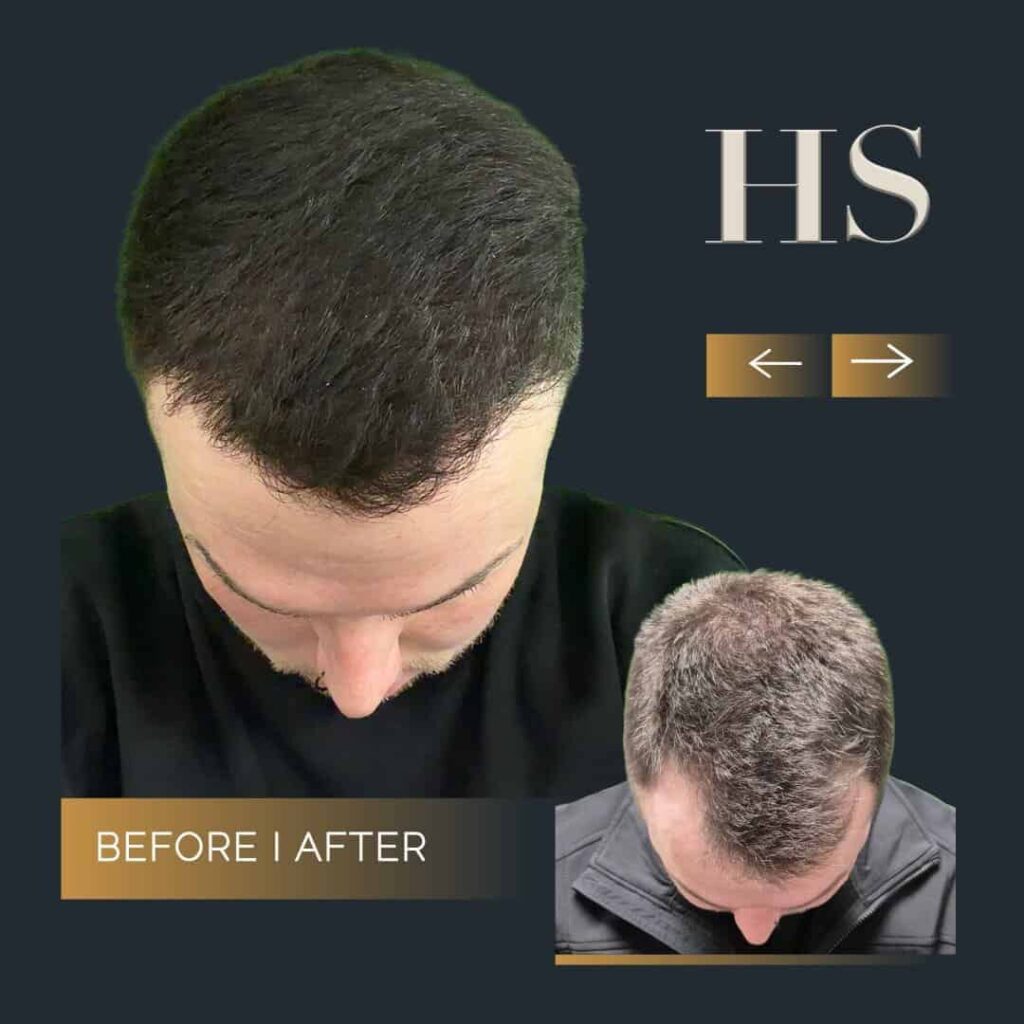
Before and After Hair Transplant Results in Belfast
A selection of results from patients treated at our Belfast clinic. All procedures were performed by our GMC-registered surgeons.


FUE and FUT for Women
FUE can be used for women with well-defined areas of loss and adequate donor density. Because FUE requires shaving the donor area, some women prefer FUT, which does not require shaving the recipient zone and allows the surrounding hair to cover both the procedure area and the donor scar during recovery.
The DHI technique is particularly useful for women with diffuse thinning because it allows follicles to be placed precisely between existing hairs without disturbing them. This makes it possible to add density to areas of partial thinning rather than just filling completely bald zones. For women with frontal hairline recession, the approach is the same as a hairline hair transplant. For thinning at the crown, a crown hair transplant assessment will determine whether the donor supply is adequate.
Other Causes of Hair Loss in Women
Female hair loss is not always androgenetic. Traction alopecia from tight hairstyling causes hairline recession and can be corrected with transplantation once the pulling habit is stopped. Women who also have thinning eyebrows may consider an eyebrow transplant as a separate procedure. For transgender women, hair restoration is often an important part of the transition journey and requires specific assessment around hormone therapy history. Beard transplants for trans men are a separate category not typically relevant to female hair loss patients but addressed at the same clinic and the recession has stabilised. Alopecia areata, thyroid disorders, iron deficiency, and telogen effluvium are other common causes that must be excluded or managed medically before a transplant is considered.
Our surgeons will take a full clinical history at consultation to establish the cause of hair loss before discussing a surgical approach. A transplant on active, unstable hair loss is unlikely to produce a lasting result.
Types of Female Hair Loss: Understanding the Cause
Not all female hair loss is the same, and the cause determines whether a transplant is appropriate.
Female pattern hair loss (FPHL), also called androgenetic alopecia, is the most common type. It follows the Ludwig classification, where Grade I describes mild thinning at the crown with the hairline preserved, Grade II shows widening of the central parting and more diffuse crown loss, and Grade III represents more extensive thinning across the top of the scalp. FPHL is caused by a combination of genetic sensitivity to androgens and normal hormonal changes, particularly around the menopause. The donor area at the back of the scalp is typically preserved in FPHL, which means hair transplantation is often viable.
Traction alopecia results from prolonged tension on the hairline from tight hairstyling, including ponytails, braids, extensions and tight headwear. It presents as recession along the frontal hairline and temples. The recession is often symmetrical. Once the traction habit has stopped and the hairline has been stable for at least 12 months, a transplant can restore the affected area with good predictability.
Telogen effluvium is a diffuse shedding triggered by physiological stress, such as childbirth, significant illness, rapid weight loss, or major surgery. It is usually temporary. A transplant is not appropriate during active telogen effluvium. Medical review and a period of recovery are needed first.
Alopecia areata is an autoimmune condition causing patchy hair loss. It can affect the eyebrows and scalp. It must be in stable remission before surgery is considered.
When Medical Treatment Comes First
For women with early-stage female pattern hair loss, surgery is not always the right first step. Minoxidil applied topically to the scalp has good evidence for maintaining and in some cases recovering hair density in FPHL. Results from minoxidil take four to six months to assess and require ongoing use to sustain the benefit. For patients whose thinning has only recently become noticeable, trying minoxidil for six months before committing to surgery is a reasonable approach.
Low-level laser therapy (LLLT) is another non-surgical option with evidence of benefit in some forms of diffuse female hair loss. It can be used alongside minoxidil. Neither replaces a transplant for patients with established thinning in a defined area, but for patients earlier in the process they can slow progression and delay or reduce the scale of surgery required.
Our surgeons will discuss the full range of options at your consultation and will always recommend the least invasive appropriate approach for your stage of hair loss.
What Makes Women Good Candidates for a Hair Transplant?
The most important factor is donor hair quality. A woman with female pattern hair loss whose back-of-scalp donor area retains good density is a strong candidate. The donor hair must be stable, meaning it will not miniaturise over time after it has been transplanted.
Women with traction alopecia along the hairline, where the donor area is entirely unaffected, are typically excellent candidates because the cause of loss has been removed and the donor supply is normal.
Women who cannot shave the donor area for professional or personal reasons should know that FUT allows the donor strip to be taken from beneath long hair with a small shaved section that the surrounding hair covers immediately. This is one reason some women prefer FUT over FUE for scalp procedures.
Cost
Pricing for hair transplants in women is based on graft count, confirmed at consultation. See our hair transplant costs. Finance is available on our hair transplant finance.
Next Steps for your Hair Transplant in Belfast
1) Get in Touch With Us

During the initial call, we will make arrangements to schedule a consultation at a convenient date and time.
2) FREE Online Consultation

The FREE online consultation will give us the opportunity to discuss your concerns and identify the most advantageous treatment plan, along with the associated treatment price.
3) Book Hair Transplant

If you’re happy with the advice and treatment proposal, all that is left to do is schedule your treatment. Let’s eliminate your hair loss and regain your confidence!
Where to Find Us
Hair Transplant Belfast
12-16 Bridge St
Belfast BT1 1LU
Call us to book your free consultation. Our team will confirm availability and answer any questions before you come in.

FAQs
The key requirement is adequate donor density at the back of the scalp. Women with female pattern hair loss that affects the donor area as well as the top of the scalp may not have reliable donor material. Women with traction alopecia along the hairline, or with well-defined areas of loss and good surrounding donor density, are often good candidates. A consultation with a clinical assessment will give you a clear answer.
Not necessarily. FUT does not require shaving the recipient area, and the donor strip can be concealed by surrounding hair. With FUE, the donor zone must be shaved, though some women have this done in a smaller section that can be covered by longer hair above it. We will discuss the options at consultation based on your specific hair loss pattern.
Yes, once the traction has stopped and the recession has been stable for at least 12 months. Active traction alopecia should not be treated with a transplant until the cause has been removed and the hairline is no longer actively receding. At consultation we will assess the stability of your recession before recommending any procedure.
Recovery is similar to men. Scabbing and redness settle within 10 to 14 days. Most women can return to a desk job within five to seven days. Transplanted hairs shed at two to four weeks, which is expected. New growth begins from around three months, with the full result at 12 to 18 months.
Transplanted hairs are resistant to the causes of female pattern hair loss. However, any existing natural hair in the thinning zones may continue to be lost over time. In some cases, medical management with treatments such as minoxidil is recommended alongside a transplant to slow ongoing loss in untreated areas. This is discussed at consultation.
Not always. For early-stage female hair loss, medical treatments including minoxidil and in some cases low-level laser therapy may be the appropriate starting point. Surgery is a better option when the loss has progressed to the point where medical treatments are not producing sufficient density. Our surgeons will discuss the full range of options at consultation.
Patient Testimonials
Aside from achieving fantastic results, we believe that keeping in touch with our patients before, during and after their hair transplantation procedure is paramount – it helps to keep our patients feeling calm and in control. We’re always on hand to provide guidance, support and aftercare advice. Time and again, our patients tell us that this is what sets us apart from other clinics.
You can read our great reviews of FUE hair transplants over on Google and Trustpilot