




Every procedure at Hair Transplant Belfast is led by a GMC-registered surgeon throughout
Based in the centre of Belfast, close to transport links across the city and beyond
An honest assessment of your candidacy and expected outcome, with no obligation to book
Your surgeon performs every stage of your procedure, extraction, channel creation, and implantation
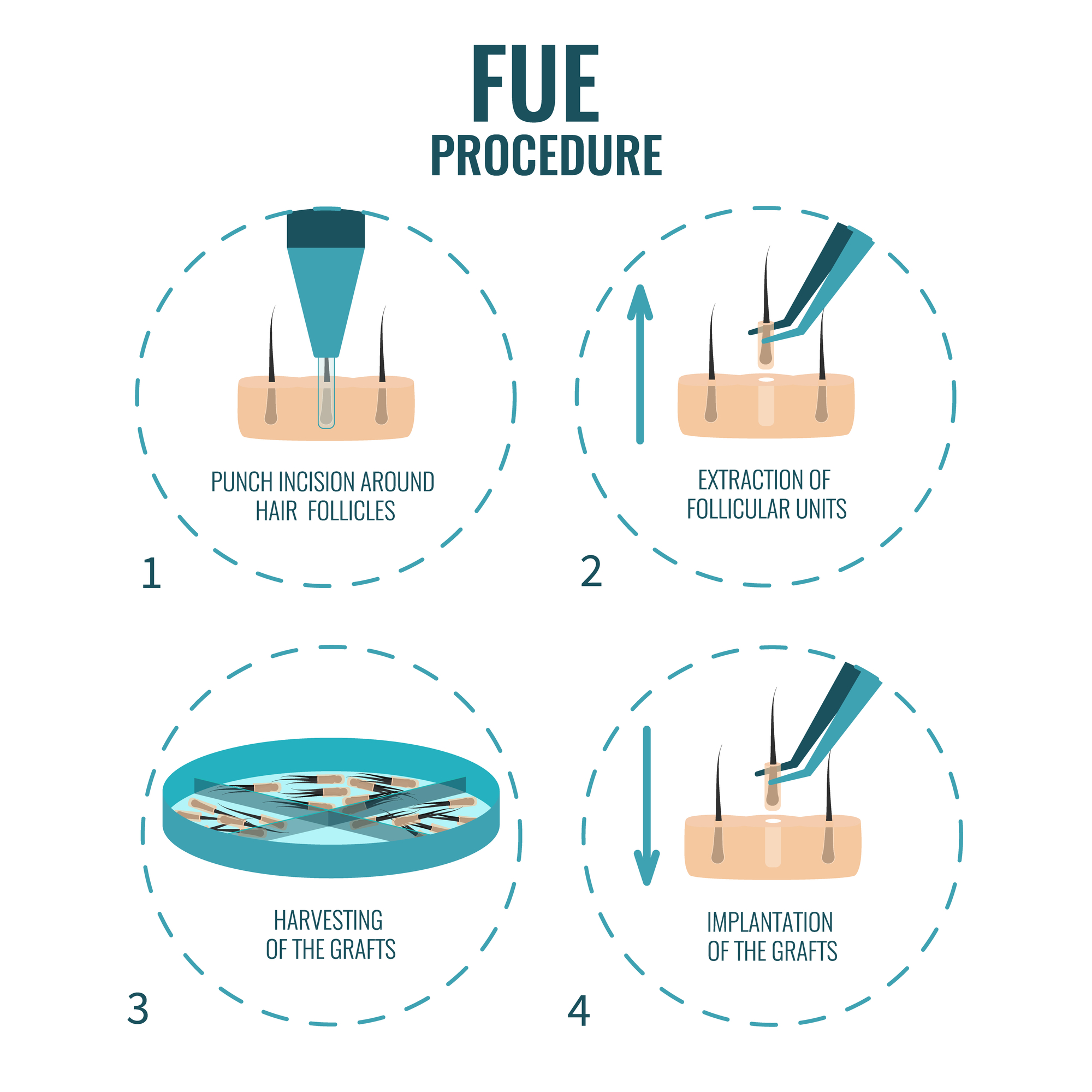
Hair Transplant Belfast uses the FUE technique for the majority of scalp hair restoration procedures. Follicular unit extraction removes individual hair follicles directly from the donor area at the back and sides of the scalp, leaving no linear scar and allowing most patients to return to normal activity within a week.
FUE Hair Transplant in Belfast
FUE is the method most patients ask about, and for good reason. The absence of a strip incision means the donor area heals with tiny dot scars rather than a line, which matters most to patients who keep their hair short. Recovery is faster than with FUT, and the technique works well across a wide range of hair loss presentations.
The procedure begins with shaving the donor zone, usually the back of the scalp. Dr. Aziz Elgindi (GMC: 7450896) or Dr. Mohammed Ditta (GMC: 7084372) uses a punch device of less than 1mm in diameter to extract individual follicular units, each containing one to four hairs. Extracted follicles are kept at a controlled temperature in a preservation solution while the recipient area is prepared.
Channels are then made in the thinning or balding zone using fine instruments. The angle, depth and direction of each channel determines how the transplanted hair will grow, which is why the design phase is critical. Follicles are then placed into these channels, one by one.
How Many Grafts Do You Need?
This depends entirely on the extent of your hair loss and the density of your donor supply. A patient with early recession around the temples might need 1,200 to 1,800 grafts. A more advanced case covering the frontal zone and crown can require 3,000 to 4,000 or more. The only accurate estimate comes after a scalp assessment at consultation.
We work within your available donor supply. Overharvesting is a risk with high-volume FUE and we are conservative by practice. Spreading an inadequate donor pool thinly across a large area produces poor density everywhere. A focused result with genuine density in the areas that matter most is always the better clinical outcome. For patients with frontal recession, see our hairline hair transplant page. For crown thinning, see crown hair transplant.
FUE vs DHI
The DHI technique loads extracted follicles directly into a Choi implanter pen and places them without pre-made channels. This gives the surgeon additional control over angle and direction, which makes it particularly well suited to work around existing hair and for eyebrow transplant or beard transplant restoration. FUE with pre-made channels is the standard approach for scalp hair restoration, particularly where the recipient area is largely bare.
FUE vs FUT
FUT removes a strip of scalp tissue from the donor area, from which follicular units are dissected under a microscope. It produces no round punch scars and can yield a higher graft count in a single session for patients with a limited donor area. FUE avoids the linear scar and suits patients who wear their hair short at the back. The right choice depends on your hair loss stage, donor density, and what you want from the recovery.
Recovery and Results
Most patients see scabbing resolve within 10 to 14 days. Transplanted hairs shed at around two to four weeks, which is expected and not a cause for concern. The follicles remain in place and new growth begins at around three to four months. Meaningful density is visible from six months, with the final result at 12 to 18 months.
Results are permanent because the transplanted follicles come from the permanent donor zone, which is resistant to the hormone DHT that causes male pattern hair loss.
What Happens on the Day of Your FUE Procedure
You arrive at the clinic in the morning. The donor area at the back of the scalp is trimmed and the hairline or recipient zone is marked out with the surgeon before any anaesthetic is administered. This design phase takes place while you are fully alert so you can review and confirm the plan.
Local anaesthetic is then applied to the donor area. The injections are brief and the area is numb within a few minutes. Dr. Aziz Elgindi (GMC: 7450896) or Dr. Mohammed Ditta (GMC: 7084372) extracts follicular units individually using a micro-punch of less than 1mm in diameter. Grafts are placed in a chilled holding solution as they are collected, a step that preserves follicle viability during the extraction phase.
Once the required grafts have been collected, the local anaesthetic is transferred to the recipient area. Fine recipient channels or implanter positions are created, matching the natural angle and direction of your existing hair. Each follicle is then placed individually. The procedure typically takes six to eight hours for sessions of 1,500 to 2,500 grafts. You can eat, rest and take breaks throughout the day. Most patients go home the same evening.
Who Is a Good Candidate for FUE in Belfast?
Most men and women experiencing stable hair loss are candidates. The primary requirement is adequate donor density at the back and sides of the scalp. Patients whose hair loss is still actively progressing may be better served by starting medical treatment first to stabilise the pattern before surgery is planned.
Age is less important than hair loss stability. A 25-year-old with a stable, well-defined recession pattern and good donor density can be an appropriate candidate. A 40-year-old with rapidly advancing diffuse thinning may not be. Norwood scale classification is a useful starting point, but donor assessment is always the deciding factor.
Women with hair loss are assessed on the same basis. Adequate donor density and a well-defined pattern of loss are the key criteria. Transgender patients are assessed with specific attention to hormone therapy history and its effect on hair loss pattern and stability.
Travelling for FUE in Belfast
Hair Transplant Belfast sees patients from across Northern Ireland and the Republic of Ireland. The clinic is located at 12-16 Bridge Street in Belfast city centre, within a 10-minute walk of Great Victoria Street station and a short taxi from Belfast Central.
Patients from Derry travel around 70 miles via the A6, typically 75 to 90 minutes by car. From Newry it is around 35 miles south via the A1, approximately 45 minutes. Lisburn is less than 10 miles and under 20 minutes. Antrim and Ballymena are 20 to 30 miles north, both under 45 minutes via the M2. Patients from Bangor and the Ards Peninsula typically take around 25 minutes on the A2. Airport connections via Belfast International and George Best Belfast City Airport mean patients travelling from further afield can complete the procedure in a single day without an overnight stay in most cases.
Before and After FUE Hair Transplant Results in Belfast
A selection of results from patients treated at our Belfast clinic. Every procedure shown was performed by our GMC-registered surgeons. View the full gallery.


Cost
Pricing at Hair Transplant Belfast is based on graft count, confirmed at consultation. See our hair transplant costs for the full breakdown. Finance is available via our hair transplant finance.
Next Steps for your Hair Transplant in Belfast
1) Get in Touch With Us

During the initial call, we will make arrangements to schedule a consultation at a convenient date and time.
2) FREE Online Consultation

The FREE online consultation will give us the opportunity to discuss your concerns and identify the most advantageous treatment plan, along with the associated treatment price.
3) Book Hair Transplant

If you’re happy with the advice and treatment proposal, all that is left to do is schedule your treatment. Let’s eliminate your hair loss and regain your confidence!
Where to Find Us
Hair Transplant Belfast
12-16 Bridge St
Belfast BT1 1LU
Call us to book your free consultation. Our team will confirm availability and answer any questions before you come in.
FAQs
Most patients with male or female pattern hair loss are candidates. The key requirement is adequate donor density at the back and sides of the scalp. Patients with very little donor hair, active autoimmune conditions affecting the scalp, or unrealistic expectations about achievable density may not be suitable. A consultation will give you a clear answer. Women with hair loss and transgender patients are also assessed on the same basis, with the same key factors: donor quality and stability of the hair loss pattern.
The scalp is anaesthetised before extraction begins. The injections themselves are the most uncomfortable part and are brief. Once the anaesthetic is established, patients typically report very little discomfort during the procedure. The recovery involves tenderness and some tightness for the first few days, manageable with the medication provided.
A session of 1,500 to 2,500 grafts typically takes six to eight hours. Larger sessions take longer. We see one patient per surgeon per day, so your surgeon is not splitting time between procedures.
Most patients with desk jobs return to work within five to seven days. If your work involves heavy physical activity, sun exposure, or risk of sweating on the scalp, allow two weeks. The donor area and recipient area both need time to settle before significant physical exertion.
Yes. Shedding of the transplanted hairs at two to four weeks post-procedure is a normal part of the growth cycle. The follicle remains intact and new growth begins from around three months. This is called shock loss and is expected with all hair transplant techniques.
Yes. Transplanted follicles are taken from the permanent donor zone, which is genetically resistant to DHT. Once established in the recipient area, they retain this resistance and continue growing for life. Ongoing hair loss in untreated areas of the scalp is separate and may continue after the procedure.
Patient Testimonials
Aside from achieving fantastic results, we believe that keeping in touch with our patients before, during and after their hair transplantation procedure is paramount – it helps to keep our patients feeling calm and in control. We’re always on hand to provide guidance, support and aftercare advice. Time and again, our patients tell us that this is what sets us apart from other clinics.
You can read our great reviews of FUE hair transplants over on Google and Trustpilot