



Every procedure at Hair Transplant Belfast is led by a GMC-registered surgeon throughout
Based in the centre of Belfast, close to transport links across the city and beyond
An honest assessment of your candidacy and expected outcome, with no obligation to book
Your surgeon performs every stage of your procedure, extraction, channel creation, and implantation
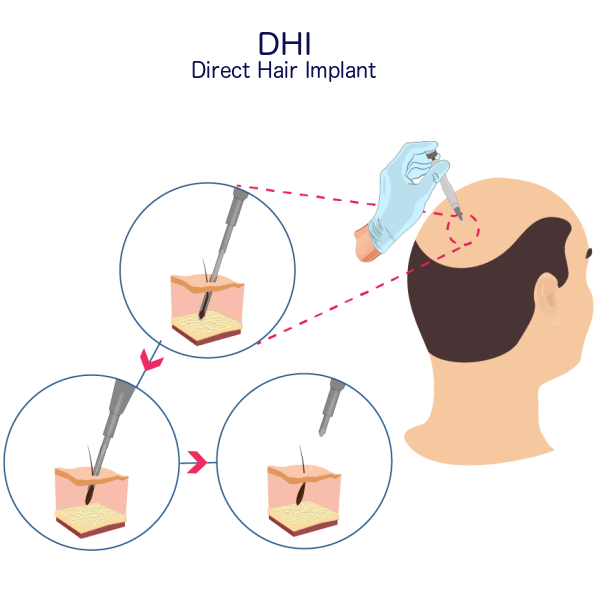
The DHI technique (Direct Hair Implantation) uses a Choi implanter pen to extract and place follicles in a single step, without the need for pre-made recipient channels. At Hair Transplant Belfast, we recommend DHI for patients requiring precise placement around existing hair, and for eyebrow and beard restoration.
DHI Hair Transplant in Belfast
The key difference between DHI and standard FUE lies in the implantation phase. With FUE, the surgeon first creates a series of recipient channels in the scalp using fine blades, then places follicles into those channels. With DHI, follicles are loaded into the Choi pen immediately after extraction and implanted directly, with the pen creating the channel and depositing the follicle in one motion.
This gives the surgeon precise control over the depth and angle of each graft at the moment of placement. In areas where existing hair is present and needs to be worked around without being disturbed, DHI produces less trauma to surrounding follicles. The technique is also favoured for smaller, detail-oriented areas such as the hairline edge, eyebrow restoration, and beard transplantation.
Who Is a Good Candidate?
Patients with partially thinning areas who still have good coverage in some zones are often the best candidates for DHI. Because the technique avoids pre-made channels, the surgeon can work more precisely between existing hairs. Patients with very large areas of complete baldness may still do better with standard FUE, where pre-made channels allow more efficient graft placement over a larger recipient zone.
Beard and eyebrow restoration consistently produces good results with DHI because the pen allows follicles to be placed at exactly the right angle and direction to mimic the natural growth pattern of these areas. If you are considering a beard transplant or eyebrow restoration, DHI is our preferred technique.
Recovery and Results
Recovery with DHI is comparable to FUE. Scabbing and redness settle within 10 to 14 days. Transplanted hairs shed at two to four weeks. Growth begins around three months, with the result fully visible at 12 to 18 months. Because DHI avoids pre-made channels, some patients find the treated area looks less red in the days immediately following, though this varies between individuals.
How the DHI Technique Works
The Choi implanter pen is the defining tool of the DHI method. It is a precision instrument with a hollow needle tip of less than 1mm in diameter. Each follicular graft is loaded individually into the tip of the pen after extraction. The surgeon then presses the pen into the recipient area, which simultaneously creates the channel and deposits the follicle in a single controlled movement.
The practical sequence is this. The donor area is trimmed and anaesthetised. Individual follicular units are extracted using a micro-punch, exactly as with standard FUE. Once extracted, each graft is immediately loaded into a Choi pen by one of the technicians working alongside the surgeon, rather than being stored in bulk in a holding solution.
During the implantation phase, two to three technicians work in rotation. The surgeon takes a loaded pen from one side of the trolley, presses it into the recipient area to create the channel and deposit the follicle simultaneously, then sets the used pen on the other side. A technician picks up the used pen, reloads it with the next graft, and returns it to the first side of the trolley. A third pen may be in preparation at the same time. This rotation continues throughout the entire implantation phase, which means the surgeon never waits between placements and each follicle spends the minimum possible time outside the body.
Different pen sizes are used depending on the hair calibre. Fine single-hair grafts used at a hairline edge require a narrower pen than multi-hair grafts placed in a denser area. Surgeons experienced in DHI typically work with several pen sizes in a single session, switching as the work moves from edge placements to density work.
This process means no pre-made channels are cut into the recipient scalp before implantation. In areas where existing hair is present, this matters because there is no period where open channels are sitting unoccupied next to existing follicles. The trauma to surrounding hair is reduced and recovery of the treated area typically looks less disrupted in the days immediately following.
DHI vs FUE: Choosing the Right Technique
The choice between DHI and standard FUE is determined primarily by the area being treated and the density goal. For patients targeting a large, largely bare recipient zone, FUE with pre-made channels is more efficient. Creating channels in bulk across a wide area is faster when working with high graft counts. A session of 3,000 or more grafts over a large recipient zone is technically demanding with DHI and most surgeons working at that scale use FUE.
For patients targeting a smaller, well-defined area where precision matters more than speed, DHI has real advantages. Working around existing hair, placing grafts at very precise angles in a compact zone, and building density in areas like the hairline edge, beard or eyebrow are all situations where the Choi pen gives the surgeon control that pre-made channels cannot replicate.
At Hair Transplant Belfast, both techniques are available. The recommendation at your consultation will reflect the area, the graft count, your existing hair and the result you are trying to achieve. In some cases, a combined approach is used, with DHI for precision work around existing hair and FUE for broader coverage in the same session.
DHI Uses FUE Extraction: What This Means for Your Procedure
There is a common misconception that DHI and FUE are competing alternatives, as if choosing DHI means choosing a different extraction method. They are not. DHI describes the implantation phase only. The extraction phase of a DHI procedure is standard FUE.
This means that before a single Choi pen is used, the donor area at the back of the scalp is trimmed and individual follicular units are extracted one by one using a fine micro-punch, in exactly the same way as a conventional FUE hair transplant. The difference is what happens next. In standard FUE, the surgeon creates a series of recipient channels in the scalp first, then places the follicles into those pre-made channels. In DHI, each follicle goes straight from extraction into a Choi pen, and the pen is used to simultaneously create the channel and place the graft in a single motion.
The phrase “no-shave DHI” is also worth clarifying. When this is offered, it means the recipient area (the area where grafts are being placed) does not need to be shaved. Existing hair can be worked around with the Choi pen without disturbing it. The donor area at the back of the scalp is always shaved regardless, because the micro-punch extraction requires access to the scalp surface. A patient who is told they can have a completely unshaved DHI procedure should ask specifically about the donor area, because that portion is always clipped short before extraction.
Understanding this distinction is useful for anyone weighing up their options. A DHI procedure involves the same extraction commitment as FUE, with the addition of the Choi pen implantation technique in the placement phase.
Before and After DHI Hair Transplant Results in Belfast
A selection of results from patients treated at our Belfast clinic. Every procedure shown was performed by our GMC-registered surgeons. View the full gallery.


Cost
DHI is priced on graft count, confirmed after your consultation and scalp assessment. See our hair transplant costs for the full pricing schedule. Finance is available via our hair transplant finance.
Next Steps for your Hair Transplant in Belfast
1) Get in Touch With Us

During the initial call, we will make arrangements to schedule a consultation at a convenient date and time.
2) FREE Online Consultation

The FREE online consultation will give us the opportunity to discuss your concerns and identify the most advantageous treatment plan, along with the associated treatment price.
3) Book Hair Transplant

If you’re happy with the advice and treatment proposal, all that is left to do is schedule your treatment. Let’s eliminate your hair loss and regain your confidence!
Where to Find Us
Hair Transplant Belfast
12-16 Bridge St
Belfast BT1 1LU
Call us to book your free consultation. Our team will confirm availability and answer any questions before you come in.
FAQs
The Choi implanter pen is a fine surgical instrument with a hollow needle tip. The follicle is loaded into the tip of the pen, which is then pressed into the scalp to create a channel and deposit the graft simultaneously. The pen has a diameter of less than 1mm. Different pen sizes are used for different follicle sizes.
Neither is universally better. DHI offers advantages in precision placement, working around existing hair, and in beard and eyebrow restoration. Standard FUE with pre-made channels is more efficient for large recipient areas, and FUT is sometimes the better choice for patients needing very high graft counts in a single session. The right technique for you depends on your hair loss pattern, the recipient area, and whether existing hair needs to be preserved.
DHI leaves the same small dot scars in the donor area as FUE. These are typically less than 1mm in diameter and are not visible at normal hair lengths. There is no linear scar and no stitches required.
Yes. DHI is suitable for female hair loss where diffuse thinning has left partial coverage in the recipient area. The ability to place grafts precisely between existing hairs without disturbing them makes it a good option for women who do not want to shave the recipient zone. A consultation will confirm whether this approach is appropriate for your specific presentation. DHI is also used in transgender hair restoration for both hairline feminisation and beard work for trans men. Patients wanting hairline transplant or crown restoration can discuss whether DHI or standard FUE is more appropriate at the same consultation. For women with hair loss, DHI is frequently the preferred approach where existing hair in the recipient area needs to be preserved.
Most patients are back to normal daily activity within five to seven days. Strenuous physical activity, direct sun exposure, and swimming should be avoided for two weeks. The transplanted hairs shed at around two to four weeks, which is normal, and new growth begins from three months.
Yes. Both Dr. Aziz Elgindi and Dr. Mohammed Ditta are trained in the DHI technique. At your consultation, they will advise whether DHI or standard FUE is more appropriate based on your hair loss pattern and treatment goals.
Patient Testimonials
Aside from achieving fantastic results, we believe that keeping in touch with our patients before, during and after their hair transplantation procedure is paramount – it helps to keep our patients feeling calm and in control. We’re always on hand to provide guidance, support and aftercare advice. Time and again, our patients tell us that this is what sets us apart from other clinics.
You can read our great reviews of FUE hair transplants over on Google and Trustpilot